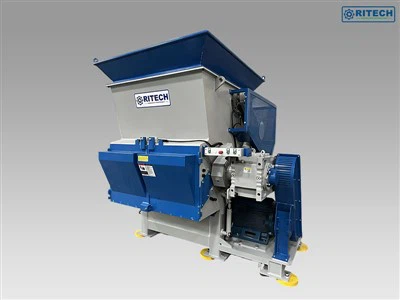
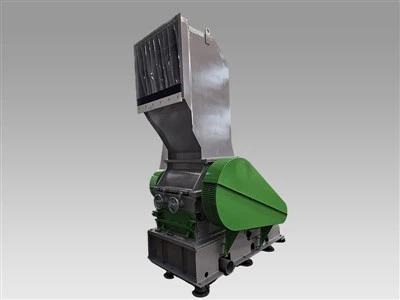
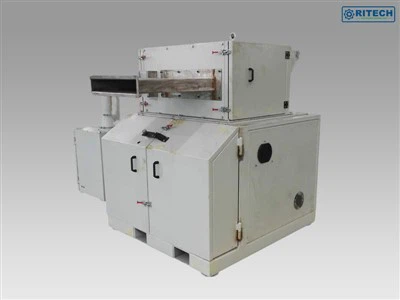
The granulator mainly consists of a feeding, mixing, granulation, transmission, and lubrication system. Its working process involves feeding powder with a moisture content not exceeding 15% into the feeding auger from the hopper. The appropriate material flow rate is obtained by adjusting the speed of the continuously variable motor. The powder then enters the mixer, where it is agitated and mixed with steam for conditioning. If molasses or oil needs to be added, it is also added through the mixing drum and conditioned with steam. The amount of oil added generally does not exceed 3%, otherwise, it will be difficult to form the granules. After conditioning, the temperature of the powder can reach 64-85℃, and the moisture content 14-16%. The powder then passes through an optional magnetic separator via a chute to remove iron impurities mixed in with the powder, and finally enters the pressing chamber for granulation.
Feeder
The feeder consists of a speed-regulating motor, a reducer, an auger cylinder, and an auger shaft.
The speed-regulating motor consists of a three-phase asynchronous AC motor, an eddy current clutch, and a tachogenerator. It works in conjunction with a JZT controller, and its output speed can be changed through a JDIA type electromagnetic speed-regulating motor controller. The feed reducer uses a cycloidal pinwheel reducer with a reduction ratio of 1.10. It is directly connected to a speed-regulating motor to reduce the effective speed of the feeding auger, keeping it between 12-120 rpm.
The feeding auger consists of an auger drum, an auger shaft, and bearing housings. The auger feeds material, and its speed is adjustable, meaning the feed rate can be varied to achieve the rated current and output. The auger shaft can be pulled out from the right end of the auger drum for cleaning and maintenance.