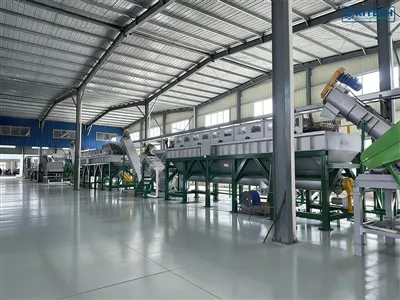
The Plastic Washing Line's process revolves around plastic recycling and cleaning. Its core function is to remove stains, impurities, and contaminants from the plastic surface, laying the foundation for subsequent recycling. The overall process is coherent and orderly, mainly divided into four key stages. Each stage is closely connected and performs its own function to ensure that the quality of the cleaned plastic meets the standards.
1. Raw material sorting and pretreatment
The recycled waste plastics are centrally sorted to remove non-plastic impurities such as metal, stones, fabric, and wood, preventing these impurities from damaging equipment or affecting cleaning results in subsequent processes. Simultaneously, the sorted plastics undergo preliminary crushing, breaking large pieces into uniformly sized fragments to facilitate penetration of the cleaning solution and improve cleaning efficiency.
2. Pre-cleaning and impurity removal
The crushed plastic fragments are fed into a pre-cleaning tank, where an appropriate amount of water and a small amount of cleaning agent are added. Through stirring and spraying, easily cleanable contaminants such as floating dust, mud, and loose oil stains adhering to the plastic surface are removed. After pre-cleaning, filtration separates the wastewater and residual impurities, reducing the burden on subsequent deep cleaning and ensuring more targeted cleaning.

3. Deep cleaning and stain removal
The pre-cleaned plastic fragments then enter the deep cleaning stage. The cleaning water temperature and cleaning agent ratio are adjusted according to the degree of plastic contamination. Through methods such as brush rolling, high-pressure spraying, and ultrasonic cleaning, stubborn oil stains, dirt, printed patterns, and other difficult-to-remove contaminants on the plastic surface are thoroughly removed. This stage requires sufficient cleaning time to ensure that the plastic surface is free of obvious stains, odors, and cleaning agent residue.
4. Dehydration and drying before discharging.
After deep cleaning, the plastic fragments are fed into a dehydration device, where centrifugal dehydration and pressing dehydration remove a large amount of moisture adhering to the plastic surface. The dehydrated plastic is then sent to a dryer, where hot air is used to dry it, reducing the moisture content to a standard range to prevent mold and deterioration during storage. Finally, after screening and inspection, qualified plastic granules are discharged and enter the subsequent recycling process.
More about the agriculture film washing lines or ABS PS PVC Washing Machine process , please contact RITECH for further information. Our professional team is always ready to listen to your needs and provide you with customized consultation and guidance.